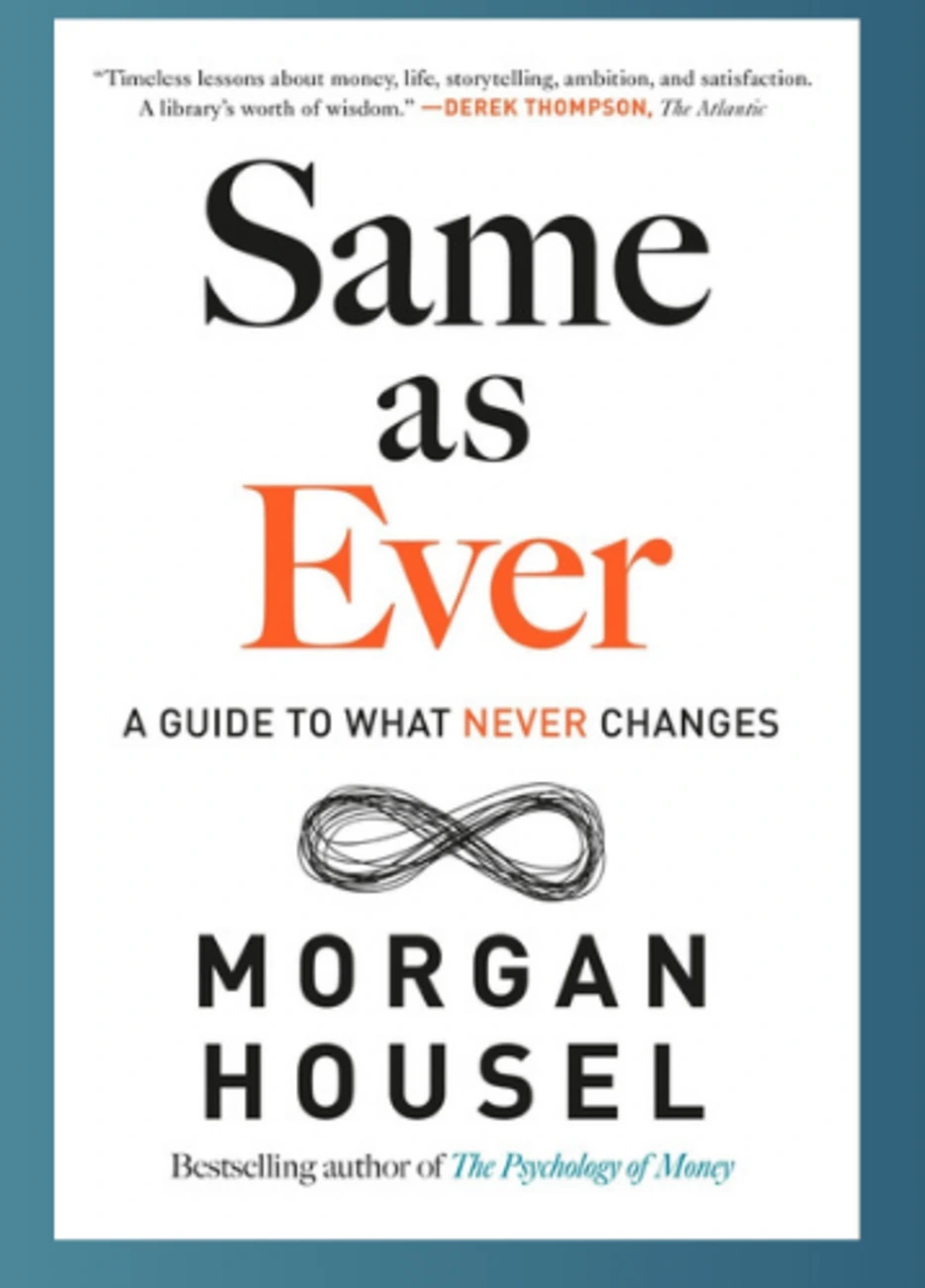
Same as ever
The behaviors that never change are history’s most powerful lessons, because they preview what to expect in the future. Your future. Everyone’s future.
+++
if you know where we’ve been, you realize we have no idea where we’re going. Events compound in unfathomable ways.
+++
Predicting what the world will look like fifty years from now is impossible. But predicting that people will still respond to greed, fear, opportunity, exploitation, risk, uncertainty, tribal affiliations, and social persuasion in the same way is a bet I’d take.
+++
The absurdity of past connections should humble your confidence in predicting future ones.
+++
financial advisor Carl Richards says, “Risk is what’s left over after you think you’ve thought of everything.”
+++
History knows three things:
1) what’s been photographed,
2) what someone wrote down or recorded, and
3) the words spoken by people whom historians and journalists wanted to interview and who agreed to be interviewed.
And all three suffer from misinterpretation, incompleteness, embellishment, lying, and selective memory.
+++
Daniel Kahneman says, “The idea that what you don’t see might refute everything you believe just doesn’t occur to us.”
+++
Nassim Taleb says, “Invest in preparedness, not in prediction.”
+++
how much debt you think you should handle— whatever you think it is, the reality is probably a little less.
+++
Charlie Munger replied:
The first rule of a happy life is low expectations. If you have unrealistic expectations you’re going to be miserable your whole life. You want to have reasonable expectations and take life’s results, good and bad, as they happen with a certain amount of stoicism.
+++
Montesquieu wrote 275 years ago, “If you only wished to be happy, this could be easily accomplished; but we wish to be happier than other people, and this is always difficult, for we believe others to be happier than they are.”
+++
Charlie Munger once noted that the world isn’t driven by greed; it’s driven by envy.
+++
Brent has a related theory about marriage: It only works when both people want to help their spouse while expecting nothing in return. If you both do that, you’re both pleasantly surprised.
+++
People who think about the world in unique ways you like also think about the world in unique ways you won’t like.
+++
People don’t want accuracy. They want certainty.
+++
A one-hundred-year event doesn’t mean it happens every one hundred years. It means there’s about a 1 percent chance of it occurring in any given year. That seems low. But when there are hundreds of different independent one-hundred-year events, what are the odds that one of them will occur in a given year?
Pretty good.
If next year there’s a 1 percent chance of a new disastrous pandemic, a 1 percent chance of a crippling depression, a 1 percent chance of a catastrophic flood, a 1 percent chance of political collapse, and on and on, then the odds that something bad will happen next year—or any year— are . . . not bad.
+++
Stories are always more powerful than statistics.
+++
If you’ve relied on data and logic alone to make sense of the economy, you’d have been confused for a hundred years straight.
+++
Per Bylund once noted: “The concept of economic value is easy: whatever someone wants has value, regardless of the reason (if any).”
+++
The ones who thrive long term are those who understand the real world is a never-ending chain of absurdity, confusion, messy relationships, and imperfect people.
+++
A common irony goes like this:
• Paranoia leads to success because it keeps you on your toes.
• But paranoia is stressful, so you abandon it quickly once you achieve success.
• Now you’ve abandoned what made you successful and you begin to decline—which is even more stressful.
+++
“For every type of animal there is a most convenient size, and a change in size inevitably carries with it a change of form,” Haldane wrote.
+++
Slow growth allows increased allocation to maintenance and repair
+++
Stress focuses your attention in ways good times can’t. It kills procrastination and indecision, taking what you need to get done and shoving it so close to your face that you have no choice but to pursue it, right now and to the best of your ability.
+++
Big, fast changes happen only when they’re forced by necessity.
+++
Warren Buffett says it takes twenty years to build a reputation and five minutes to destroy one.
+++
Tens of billions of individual steps have to go right in the correct order to create a human. But only one thing has to happen to cause its demise.
(note: This is the power of Allah)
+++
Incentives are the most powerful force in the world and can get people to justify or defend almost anything.
+++
“Which of my current views would change if my incentives were different?”
+++
Jim Carrey once said, “I think everybody should get rich and famous and do everything they ever dreamed of so they can see that it’s not the answer.”
+++
Baseball player Dan Quisenberry once said, “The future is much like the present, only longer.”
+++
Doing long-term thinking well requires identifying when you’re being patient versus just stubborn. Not an easy thing to do. The only solution is knowing the very few things in your industry that will never change and putting everything else in a bucket that’s in constant need of updating and adapting.
+++
John Maynard Keynes: “In the long run we’re all dead.”
+++
one of the top cancer researchers in the world, and he’s saying he could make a bigger impact on cancer if he focused on getting people to quit smoking—but that’s not intellectually stimulating enough for him. Or for many scientists, for that matter.
Now, I don’t blame him—and Weinberg has added enormous value to the war on cancer.
But here we have an example of complexity being favored for its excitement, when simplicity may actually do a better job.
+++
The sore truth is that ==complexity sells better.==
+++
A trick to learning a complicated topic is realizing how many complex details are cousins of something simple.
+++
John Reed wrote in his book Succeeding:
When you first start to study a field, it seems like you have to memorize a zillion things. You don’t. What you need is to identify the core principles—generally three to twelve of them— that govern the field. The million things you thought you had to memorize are simply various combinations of the core principles.
+++
Stephen King explains in his book On Writing:
This is a short book because most books about writing are filled with bullshit. I figured the shorter the book, the less bullshit.
+++
Complexity gives a comforting impression of control, while simplicity is hard to distinguish from cluelessness.
+++
truth that applies to almost every field is that there are no points awarded for difficulty.
+++
“What have you experienced that I haven’t that makes you believe what you do? And would I think about the world like you do if I experienced what you have?”
2025